Brussels hosts a wealth of events every year: concerts, trade fairs, galas, festivals, international conferences and corporate parties. The venues are as varied as the formats: the vast halls of Brussels Expo and the Palais at Heysel, converted industrial spaces such as Tour & Taxis, concert venues like Forest National, Ancienne Belgique, Cirque Royal or Botanique, cultural venues such as Bozar or Flagey, not to mention open-air events in Cinquantenaire Park, on the Mont des Arts or in the Bois de la Cambre. Each comes with its own security constraints. This guide sets out the key steps in organising security for your event, whatever its size.
Start with a risk assessment
Event security is built long before the big day. The first step is to answer a few simple but decisive questions:
- Who is coming? Expected attendance, audience profile (professionals, families, young adults), presence of public figures or VIPs.
- Where? Indoor or open-air, capacity, number of entrances and exits, surroundings, access for emergency vehicles.
- What format? Seated or standing, timings, alcohol, build-up and breakdown, valuable equipment on site.
- What context? Other events in the area on the same day, weather, nearby roadworks, the general threat level.
This assessment determines the scale of the arrangements: number of guards, posts, hours, search requirements and any close protection. It also forms the basis of discussions with the venue, the municipality and the emergency services.
Access control and accreditation
Access control is an event’s first line of defence, and often the first contact between your guests and your organisation. It must be both rigorous and welcoming.
- Access policy: tickets, personal invitations, guest lists, wristbands, badges.
- Accreditation: decide in advance which areas each category can access (public, press, exhibitors, artists, technicians, suppliers, VIPs) and make them easy to identify visually.
- Checkpoints: enough lanes to avoid long waits, clear signage and dedicated access for people with reduced mobility.
- Sensitive areas: backstage, dressing rooms, control room, stock and cash points, with tighter screening.
Searches and bag checks: a strict legal framework
Important: this information is a general summary and does not constitute legal advice. Check the official texts and the information published by the FPS Home Affairs for your situation.
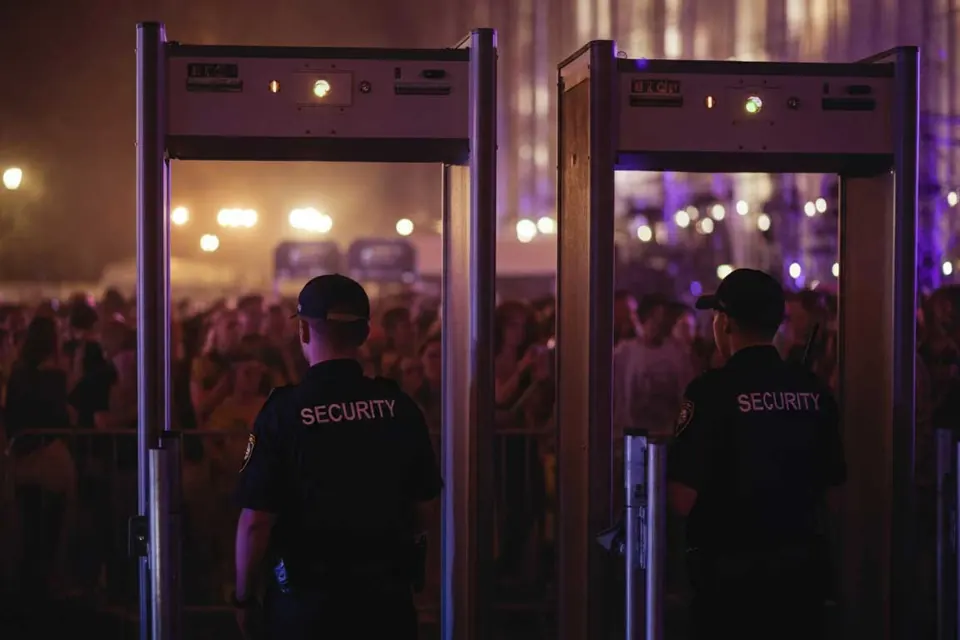
In Belgium, private security is governed by the Act of 2 October 2017 regulating private and special security. Access control with a superficial check of clothing and bags at events is one of the strictly regulated tasks: it may only be carried out by authorised guards, under the conditions laid down in the regulations. In principle, it requires the consent of the person being checked; someone who refuses may be denied entry, but cannot be forced. A private security guard does not have police powers.
In practice, tell your audience clearly in advance (ticketing, website, signage) which items are banned and what checks to expect. This reduces tension at the entrance and makes for a smoother welcome.
Crowd management and evacuation planning
Crowd management lies at the heart of event security. The critical moments are well known: doors opening, the interval, the end of a concert, guests all heading for public transport at once.
- Map the flows: entrances, exits, internal circulation, gathering areas, food outlets and toilets.
- Anticipate bottlenecks: stairs, narrow doors, cloakroom queues, the approach to a metro station or tram stop.
- Plan for evacuation: clear, signposted emergency exits, instructions known to every team, each guard’s role in an alert, assembly points.
- Organise dispersal: a gradual, managed exit limits crowding and disturbance for local residents.
The evacuation plan is drawn up with the venue manager, who knows the building and its own procedures.
Coordination with the organiser, the venue and the authorities
An event brings together many players: organiser, venue manager, stage manager, caterer, technicians, first-aiders and, depending on the case, the municipality, the police, the fire service and emergency medical services. Security only works if everyone is working from the same plan.
- A clear command structure: a named security manager, post supervisors and defined communication channels (radios, emergency numbers).
- A briefing before opening: instructions, site plan, sensitive points, emergency procedures.
- A debrief and report: incidents, areas for improvement, recommendations for the next edition.
Paperwork to plan for
Depending on the size of the event, the venue and whether it takes place in a public space, you may need to complete formalities with the municipality and the local police zone, sometimes well ahead of the date. Requirements and lead times vary between municipalities and by type of event: check with the relevant municipal administration as early as possible, as well as with the venue manager. Private security arrangements complement, but never replace, the measures decided by the authorities.
Getting ready for the day: the organiser’s checklist
A few weeks before the event, take the time to go through the following points with your security provider and the venue manager. This checklist is not exhaustive, but it covers the most common oversights:
- The site plan: an up-to-date version showing entrances, emergency exits, security posts, restricted areas and first-aid points.
- The schedule: build-up, doors opening, highlights, closing and breakdown. Security often starts when the equipment arrives and ends after the last suppliers have left.
- The lists: guests, exhibitors, press, suppliers and accredited staff, sent early enough to be checked.
- The contacts: a reachable number for each lead (organisation, venue, technical, first aid, security), shared with everyone.
- Communication with the public: banned items, opening times, public transport access, guidance for people with reduced mobility.
- The “what if” scenario: what happens if a storm hits an open-air event, someone collapses in the crowd, an artist is late or the power goes off?
An experienced provider will help you complete this list for your format. If your event is held in a building that is guarded around the clock, our guide to manned guarding in Brussels explains how to dovetail event security with site guarding.
VIP protection and backstage security
When an event welcomes artists, speakers or public figures, particular care is needed: separate entrances, discreet escorting, strict control of backstage areas and dressing rooms, and coordination with their own teams. Discretion is essential here: protection should be felt without being noticed.
Security and hospitality: striking the right balance
Your guests come for an experience, not to pass through a checkpoint. Staff trained in welcoming people and de-escalation, a calm and professional manner and friendly communication make all the difference. That is OWL Security’s DNA: people come first. For events held at Heysel, at Tour & Taxis, in a concert venue or in a hotel in the European Quarter, we can put together a team matched to the size and format of your project. To welcome your guests, take a look at our front-desk security service and the sectors we serve.
Planning an event in Brussels? Request your free security assessment or call us on +32 2 880 59 19: we will review your project with you and propose tailored arrangements, with no obligation. Find out more about our event security service in Brussels.