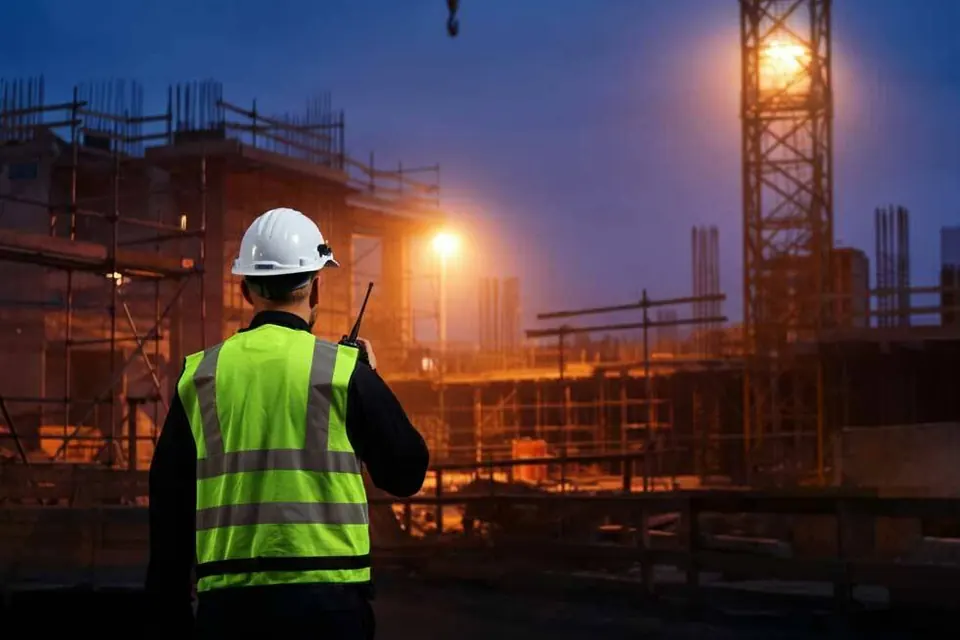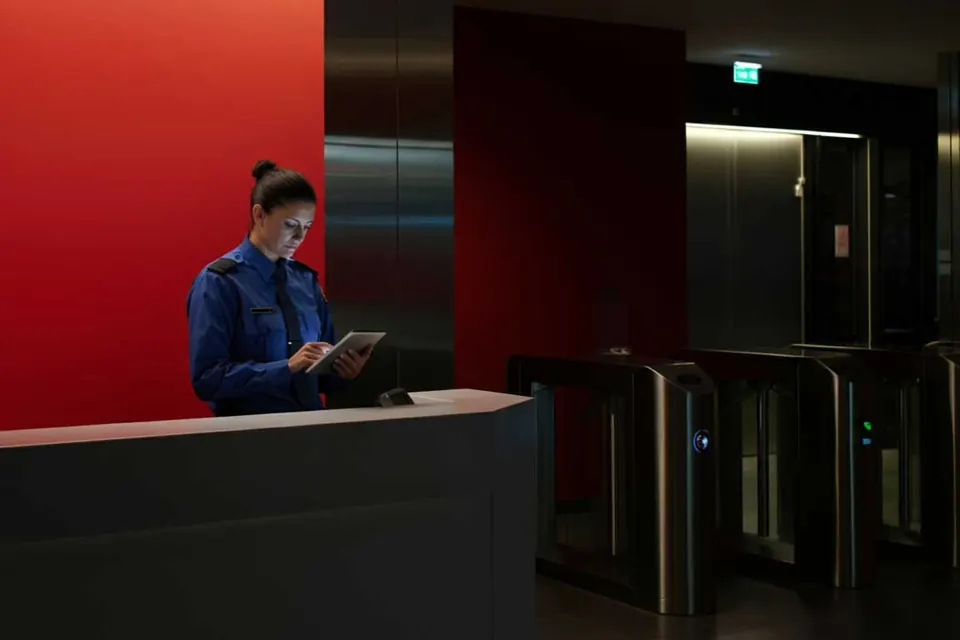
Hiring a security company is never a trivial decision. You are giving outside staff access to your premises, the protection of your assets and, often, the first contact with your visitors. In Brussels, situations vary enormously: an office building in the European Quarter or the North district, a warehouse by the canal, a shop in the city centre, a residence in Uccle or Woluwe-Saint-Pierre, a temporarily vacant site awaiting works. This guide helps you ask the right questions, understand the Belgian legal framework and choose a provider with your eyes open.
When do you need a guarding service?
The need rarely arises out of the blue. It often surfaces after an incident, during a change (a move, building works, a new activity) or when an insurer, landlord or client sets requirements. Typical situations include:
- A sensitive or high-value site: stock, IT equipment, archives or technical areas that need continuous protection.
- A building open to the public: entrances need screening, visitors need directing and inappropriate behaviour needs a calm response.
- An empty or lightly occupied site: nights, weekends, holidays or a building awaiting a new use, all of which attract intruders and squatters.
- A one-off period of risk: building works, a move, a stocktake, or an alarm or access control system that has broken down.
- An event: a reception, trade fair or open day, which then falls under event security.
The right answer is not necessarily a guard on site around the clock. It all depends on your risks, your hours and what you actually expect from the arrangements.
Manned guarding, patrols or front-desk security: what is the difference?
The three options meet different needs and can be combined. The table below summarises their main features.
| Criterion | Manned guarding | Patrols | Front-desk security |
|---|---|---|---|
| Principle | One or more guards permanently stationed at a defined post | A guard visits the site at varying times | An officer stationed at reception, combining welcome and access control |
| Main strength | Continuous deterrent presence and immediate response | Covers large areas or quiet periods | A polished first impression and screening of arrivals |
| Best suited to | Sensitive sites, storage areas, buildings left empty at night | Building sites, warehouses, car parks, sites closed at weekends | Office buildings, corporate headquarters, residences |
| Access control | Yes, at the post and across monitored areas | Spot checks of access points and locking | Yes: signing in, badges, visitor log |
| Traceability | Occurrence log and incident reports | A time-stamped report for each patrol | Visitor log and incident log |
To find out more, see our pages on manned guarding and front-desk security.
What Belgian law says about guarding
Important: this section is an informative summary and does not constitute legal advice. Regulations can change: always check the official texts and the information published by the FPS Home Affairs, and consult a lawyer if in doubt.
In Belgium, private security is governed by the Act of 2 October 2017 regulating private and special security, supplemented by implementing decrees. A few key principles are worth knowing:
- Prior licensing: a company offering guarding services to third parties must be licensed by the FPS Home Affairs (SPF Intérieur / FOD Binnenlandse Zaken). Working with an unlicensed company exposes you to risks, including as a client.
- Guards who meet strict conditions: guards must satisfy a number of requirements, including training, and hold an identification card issued under these regulations, which they wear while on duty.
- Regulated duties: what a guard may do depends on the type of activity and the location. Some tasks, such as access control with a superficial check of clothing and bags at events, are strictly regulated. A security guard does not have police powers.
In practice, do not hesitate to ask any provider, including us, for their licence number and to check it against official sources. Ask too how their guards are trained and how they make sure each guard holds a valid identification card.
How to choose your security company
Beyond legal compliance, several criteria separate a provider who simply “supplies guards” from a genuine security partner:
- A site visit before any offer: a serious quote cannot be drawn up remotely. The provider needs to understand your site, your hours and your constraints.
- A reasoned proposal: number of guards, hours, post orders and how they fit with your existing systems, all justified by the risk assessment.
- A named contact: you should know who to call, day or night, and who oversees the assignment over time.
- Guard training and continuity: guards who know your site and your teams are more effective than a constant rotation of unfamiliar faces.
- Clear reporting: occurrence log, incident reports and regular reviews with you.
- Insurance: ask which liability insurance covers the provider’s private security activities.
- Interpersonal skills: in an office lobby or a shop, courtesy and the ability to de-escalate matter as much as vigilance.
At OWL Security, a 100% Belgian company based in Dilbeek just outside Brussels, we put people at the heart of this relationship, backed by more than 15 years’ experience. Discover our approach and values.
How a guarding assignment works, step by step
1. Audit and risk assessment
Everything starts with a site visit: access points, sensitive areas, lighting, flows of people and deliveries, opening hours and existing systems (alarm, CCTV, access control). This analysis lets us define exactly the arrangements you need, without overdoing it.
2. Documented post orders and protocols
Post orders set out precisely what the guard must do: who to let in, how to respond to an alarm, who to notify and in what order, and which patrols to carry out. They are drafted with you and updated whenever the site changes.
3. Roll-out with a single point of contact
A SPOC (single point of contact) manages the assignment on your behalf. They coordinate the deployment of guards, respond to your requests and adjust the arrangements as needed. You never have to explain your situation to several different people.
4. Occurrence log and reports
Every shift change, patrol, visit or incident is recorded in a time-stamped occurrence log. If an incident occurs, you receive a detailed report. These documents are invaluable for understanding what happens on your site, for dealing with your insurer and for improving the arrangements.
5. Follow-up and optimisation
Regular reviews check that the arrangements remain fit for purpose: new risks, changed hours, building works, feedback from your teams. Ongoing training for the guards is part of this follow-up.
Guarding and your existing security systems
A security guard does not replace your alarm or CCTV, and vice versa. The two complement each other: electronics detect and record, people check, judge and act. If your site already has an alarm, cameras or badge-based access control, our guards can work alongside them: responding to and verifying alarms, monitoring screens where this is planned and permitted, and managing visitor badges. We do not install these systems: we work with the ones you have, in line with the rules on camera footage.
Across the Brussels-Capital Region
Offices in the City of Brussels or Etterbeek, warehouses in Anderlecht or Haren, residences in Uccle, shops in Ixelles: every neighbourhood has its own access, traffic and neighbourly constraints. We operate in all 19 municipalities: see our areas covered. If your project involves a building site, read our guide to securing a building site in Brussels as well.
Considering a guarding service for your Brussels site? Request your free security assessment or call us on +32 2 880 59 19: we will come and assess your needs and propose tailored arrangements, with no obligation and a reply within 24 hours.